
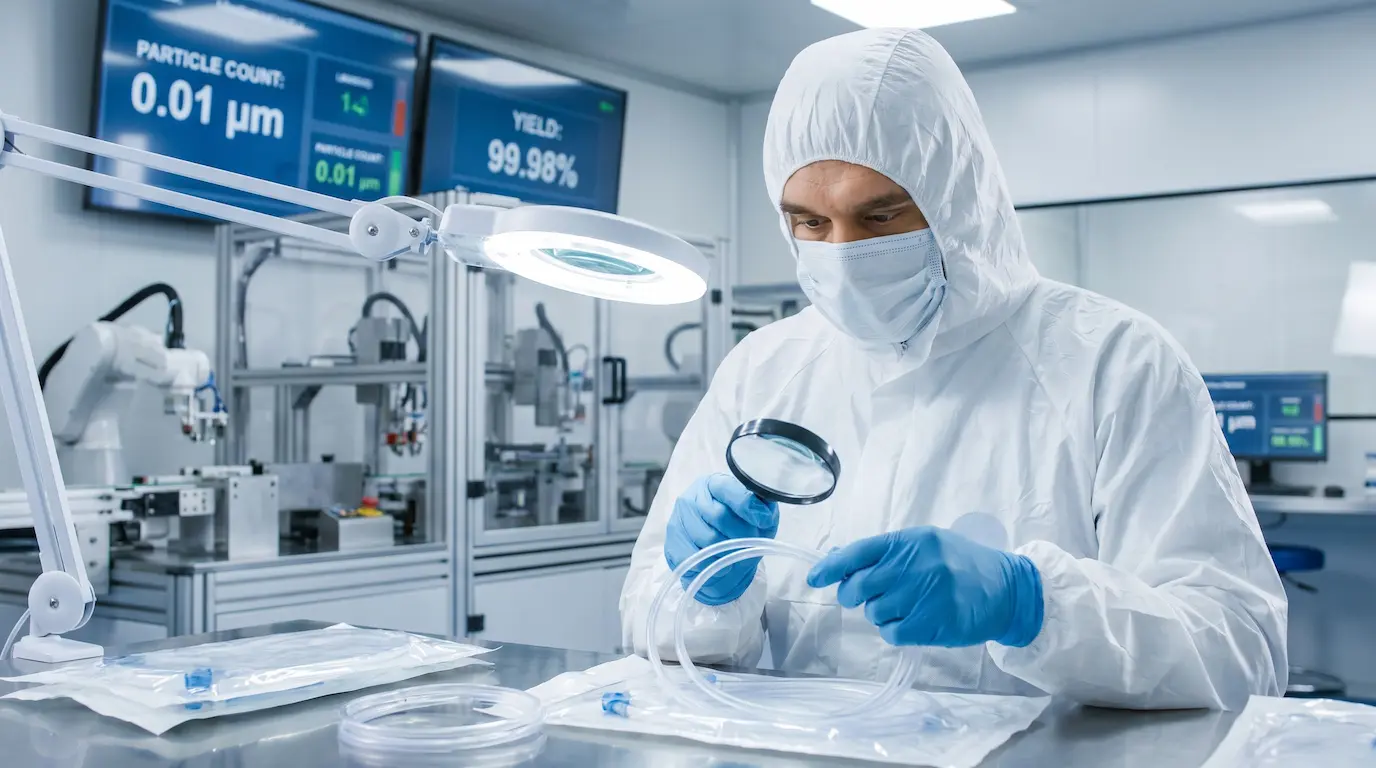
ISO 13485 Process Validation
Why Working Once Is Not Enough
Imagine baking a cake for the very first time. It turns out perfect the texture is right, the taste is excellent, and everyone loves it. Now ask yourself one critical question: Can you guarantee that the next hundred cakes will turn out exactly the same?
Probably not. Ingredients vary slightly, oven temperatures fluctuate, and baking times differ. In medical device manufacturing, producing one compliant product is a achievement. Producing thousands of identical, safe, and effective products is quality. That level of operational consistency requires structured ISO 13485 process validation.
The Core Concept Behind Process Validation
Under Clause 7 of ISO 13485, validation addresses a fundamental reality: many manufacturing processes cannot be fully verified simply by inspecting the final product.
Take medical device sterilization as an example. Once a device undergoes sterilization, you cannot verify its sterility through visual inspection. There is no non-destructive test that confirms whether every single microorganism has been eliminated. Instead, manufacturers must prove that the sterilization process itself is capable of achieving the intended outcome every single time.
The same rule applies to critical manufacturing steps like heat sealing, ultrasonic welding, automated bonding, and software-driven assembly. If the underlying process is unstable, final quality control inspections alone cannot guarantee patient safety.
What ISO 13485 Process Validation Requires
Validation is frequently misunderstood as administrative paperwork prepared strictly for auditors. In reality, ISO 13485 process validation provides objective evidence that:
- Critical parameters are defined: Temperature, pressure, speed, and environmental limits are identified.
- Operational boundaries are tested: The process is proven to work under upper and lower tolerance limits.
- Output is consistent: The system repeatedly yields compliant medical devices under normal manufacturing conditions.
Simply put, validation answers a single imperative question: Can we trust this process to deliver the exact same result every single time?
The Danger of Relying on Habit
Medical device companies often fall into the trap of assuming a process is safe because it has “always worked in the past.” However, quality cannot rely on habit or luck. Over time, several variables quietly shift on the production floor:
- Equipment wear: Mechanical components degrade and lose precision.
- Material lot changes: Raw material suppliers alter batch formulations.
- Environmental shifts: Ambient humidity and room temperatures fluctuate.
- Personnel turnover: New operators introduce subtle technique variations.
- Software updates: Automated systems undergo routine logic patches.
Without periodic review and revalidation, yesterday’s successful process quietly becomes tomorrow’s quality defect.
Building Consistency into Clause 7
Executing ISO 13485 process validation transforms Clause 7 requirements into daily operational reliability. To maintain a validated state, quality teams must focus on three core phases:
- Installation Qualification (IQ): Confirming that equipment is installed correctly according to manufacturer specifications.
- Operational Qualification (OQ): Testing the equipment across worst-case operating limits to confirm it produces acceptable results.
- Performance Qualification (PQ): Demonstrating long-term stability and repeatability under actual production conditions.
Protecting Patient Safety Through Process Control
Patients expect every medical device to perform safely and effectively, regardless of when, where, or by whom it was manufactured. They place unconditional trust in the physical product. That trust begins when manufacturers validate their own processes using hard data and scientific testing rather than assumptions.
Anyone can manufacture a single successful prototype. Leading medical device companies build validated manufacturing systems that produce identical, compliant, and safe quality every single time.